Showing posts with label flipped classroom. Show all posts

Monday, 13 July 2020

PD with a cat in your lap

If there is one positive thing that has come from this pandemic and the sudden switch to everything virtual, it's that there is a literal world of online PD available out there, and you can roll out of bed and attend it in your pjs. With a cat on your lap or not, as it happens.

Currently it seems like all the PD is happening at the same time. This week, in fact.
A screenshot of my Google Calendar. Almost all the spots are filled with some kind of online PD.
That's four conferences in one week. I'm going to be busy!

This current spate of PD (or CPD as some call it) actually started this past Saturday with the Seneca Virtual Science Conference. Seneca is a free UK homework and revision platform, and they have been offering free, short but packed conferences in all subjects, as well as pd for online teaching and free courses for teachers in things like metacognition, literacy, etc. You can check out the recorded science webinar and presentation resources at the link above. 

And yes, I had to get up at 3:45 am to attend. But it was over by breakfast time!

They are also hosting some post-conference Twitter chats this week at 7:30 pm BST. #senecaCPD


Three of the virtual conferences focus on tech or general pedagogy; scroll down if you're just interested in physics.

FlipTech2020 logo

The free FlipTech 2020 conference actually started yesterday and continues until Thursday. What I'm liking about this conference is that they are actually flipping it. You can hop in at any point; watch the videos/presentations before hand, then join the speakers for a live Q&A Zoom. The Zoom meetings are being recorded, so you can catch up if you miss something. Follow #FlipTech2020 for details and updates.

ISTE Summer Learning Academy July 13-31, 2020


ISTE is hosting a 3-week Summer Learning Academy starting today until the end of July, although you will be able to access the materials until October. It's only $US 20 (more if you want the yearly membership which gives you access to more courses). This academy is specifically focussed on online learning, which seems somewhat appropriate these days. There are daily webinars and 4 microcourses which you can work on at any time -- convenient if you happen to have filled up your schedule with other online PD! The schedule is here.

United EdTech Conference logo

I'm really pleased to be attending the 2020 United EdTech Conference this Friday and Saturday, which will be elevating BIPOC voices and examining best pedagogical practices for using edtech. The days will be short and sweet, with a 90-minute Pedagogy in Practice session followed by a 30-minute Lunch and Learn session. The webinars will be recorded and made available, which is great since there are too many good options and we can only pick one each day. Fortunately, some of the lunch and learn sessions will be repeated on day 2. The $US 10 fee will be donated to The Learning Laboratory New Orleans.

Yes, the FOMO is real.


IOP and TalkPhysics logo

I've been following the UK Institute of Physics for a while, envious of all the teacher PD they provide. They've had to move a lot of their PD online and it's been fantastic. Attending the South Region 3-day event at the beginning of July meant more 3:30 wake-up calls, but it was worth it. (And let's face it: rolling out of bed, making a cup of tea, and getting to the presentation in 15 minutes is a practice I don't really mind repeating.) I've been attending scattered workshops as well, and am on the lookout for the next Power of Per workshop since I couldn't attend last Thursday. The North West region is having their 3 days starting this Thursday until Saturday.

As for how to attend more than one workshop at once? Even with an extra Chromebook, that might be a bit much, but I'll figure it out.
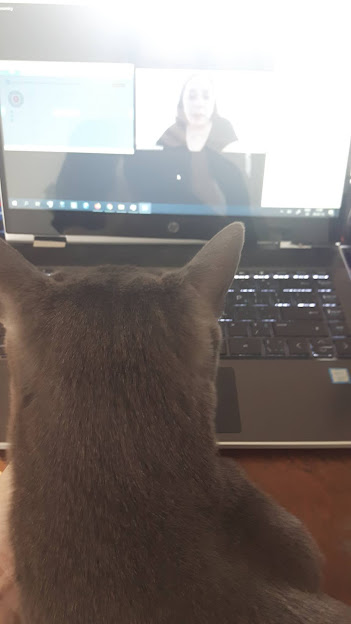
A sma;; grey cat is seen from behind, staring at a laptop screen on which there is a Zoom meeting.


Saturday, 27 October 2018

Upcoming (Really Soon!): Google Camp 6.0

Google Camp promotional poster

TDSB Google Camp 6.0 is next Saturday. It's sold out, naturally, but if you are lucky enough to go, I'll be presenting three sessions in room 218.

Session 1 is an updated and expanded version of Taking Math Digital with Desmos, Geogebra, and Equatio. Come explore tools that can make investigation in math, science, and STEM easy and fun. The Desmos graphing calculator, in particular the activity builder and activities such as Card Sort, Polygraph, and Marbleslides, is a valuable tool that makes helping students explore math concepts easy and interactive. Geogebra is a GSuite and user-friendly version of Geometer's Sketchpad. We will also talk about the updates to the Chrome extension EquatIO, helps write your math using predictive text, handwriting, and speech input, not to mention integration across all GSuite platforms.

Update: John McGowan, the creator of EquatIO, will be doing a Global Math webinar this coming Tuesday to talk about Digital Math Flow with EquatIO, Desmos, and Google. How timely!

In session 2, I will be giving an updated version of Flipping the Learning. This session will show you what a flipped lesson looks like, and how I am currently integrating flipped lessons into my math and physics classes. We will discuss the pros and cons, how it can be used for differentiated learning, and how to increase buy-in. In addition, we will discuss the technical aspects of flipping, specifically the specialized flipping platform EDpuzzle (but you can keep it as simple as YouTube and Google Forms). If you watch the video ahead of time, you will get the opportunity to delve deeper into some of the nifty features of EdPuzzle and have your first curated video ready for Monday's class!

In session 4, I'll be presenting How Random! Infinite Possibilities Using Sheets, which will talk about how to make the randomized practice sheets that are my pride and joy.  Sheets is useful for so much more than just accounting and graphs! Learn how the random number functions can be used to automagically create vocabulary lists, math problems, matching exercises, and yes, graphs... the possibilities are quite literally endless. Want to create a random question of the day? Sheets! Want the answer key, too? Sheets! Even better, you can link them to other GSuite products such as Docs, Slides, or Drawings to make collaboration easy. Sample templates will be provided so you can have a finished product ready to go for Monday's class.

It'll be a busy day, with lots of great workshops to choose from. If you can't make it to one of mine, I'll put links to the resources.

Hope to see you there!


Monday, 16 October 2017

Google Camp and Renewing Math Summit are coming...


There are some fantastic PD opportunities coming up in the next few weeks.

Google Camp 5.0 will be on November 4; sadly it has already sold out, but you can put your name on the waiting list and some of the sessions will be simulcast on Twitter. I'm thrilled to be joining some amazing speakers; I'll be presenting a follow-up session to my Flipping Your Classroom session from March -- I'm going to try modelling a flipped lesson! There will be pre-session homework (if you so choose)! I'm very excited to be talking about EquatIO and Desmos, which are two really amazing ways to take math and STEM digital. As usual during the day there will be a room with helpful helpers available if you've been running into difficulties with GAFE and need someone to walk you through the solution.

More info will be available soon at http://bit.ly/tdsbcamp


The TDSB's Renewing Math Summit on the Friday, December 1 PD day is offered to secondary teachers. The focus is on Teaching/Leading in an Equitable Classroom and 21st Century Global Competencies. I'll be giving a session called Rope-a-Slope: Inquiry in Grade 9 Math where a simple piece of rope and a measuring tape and guided inquiry can lead to learning about relationships between variables, slope, direct and indirect variation, and more. The other sessions look amazing as well -- I'd love to be able to attend them all. There might also be a drop-in room to learn more about digital math tools like Knowledgehook, Desmos, Geogebra, etc. 

Registration for TDSB secondary teachers is on K2L until November 23, or they reach capacity.

Join me!

Tuesday, 14 March 2017

#TDSBCamp 4.0

PD on a Saturday? Yes, please, especially if it's Google Camp. Yeah, yeah, fangirl, whatever. There's always so much I learn, even when I don't quite make it to the sessions I wanted to.

The day started with an excellent keynote by Jesse Brown (yes, that Jesse Brown) about how to take advantage of disruption. His biggest point for me was, of course, fail. Building failure into the model is also a feature of the growth mindset, which I'm still struggling to bring to many of my students.

gif of using query()Speaking of failures, I utterly failed to go to any sessions because I decided at the last minute that my presentations needed gifs (and why can't I stop typing figs every time?), but I've been creeping everyone's Slides ever since. There are terrific resources there; you should check them out.

The sessions I most wanted to attend were Larissa Aradj's BreakoutEDU Digital and Arianna Lambert's Digital Breakouts using Google Slides, since I've gotten really interested in making digital breakouts for assignments (and tried one out a few weeks ago -- now there's a failure story for you). David Hann's Manage GMail flow with Tasks will (hopefully) save me bunches of time. Jason Trinh's creating reports with Autocrat is something I will be looking into if/when I can no longer use EasyGrade Pro.

The Demo Slam was amazing, as usual. I really could have used Zelia Capitao Tavares's fantastic figgif-making tool earlier in the day. Larissa's winning Flippity add-on for Sheets is pretty nifty, as was present-even-though-he-wasn't-there Andrew Schmitt's 3D gifs (hah! got it right first try!), but the one I'll probably use the most is the Permanent Clipboard extension for Chrome, presented by Whitney Baker.

Can't wait until Google Camp 5.0!

----

I'll end by including the slidedecks (and a how-to video) for my presentations, but one of the things I find when I'm preparing for presentations like this is that I always learn new things. For instance, while preparing for my first session -- which was about how to make a self-marking, non-multiple choice quiz that gives immediate feedback -- I discovered that I need to revise my previous blog posts, and specifically my comments about what query() does (because it doesn't do what I thought it did, for the most part) and because I also learned about arrayformula(). Always learning!


My second session was about tools and tips for flipping lessons. The most important take-away from this presentation, I think, is "What is the best use of face-to-face time with students?"

Part of my session shills for EDpuzzle, which if you remember I learned about at STAO in November. Since then I've jumped in with both feet and lately, I've been plaguing them with suggestions for new features.


What did I learn through prepping for this presentation? I reread Flipped Learning by Bergmann and Sams and remembered the post-video reflection forms one of the teachers uses. I had let those go by the wayside since using EDpuzzle in favour of embedded quizzes, but I think I will start reintroducing two/three-question reflection forms as exit cards.


Thursday, 2 February 2017

Google Camp is coming...

Google Camp poster: I'm sharing Google Sheets: More than Just Number Crunching and Flipping Your Lessons: Tools and Tips

TDSB Google Camp 4.0 will be Saturday, March 4. At the risk of seeming like a Google Groupie, I love Google Camp; I've learned and been inspired by so much at every session I've attended -- not least during the demo slam at the end. I'm excited and more than a little trepidatious this year to be joining some amazing speakers. During the day, there will be a room with helpful helpers available if you've been running into difficulties with GAFE and need someone to walk you through the solution.

More info will be available soon at http://bit.ly/tdsbcamp, but TDSB teachers can register now through Key To Learn. This will sell out, so act now!

Sunday, 20 November 2016

STAO Saturday

stao2016 logo
Another day back in the wilds of Etobicoke for more STAO goodness.

Session 1: Flipping It with EDpuzzle with Adam Mills.

When I started flipping lessons two years ago, I made a conscious decision not to use a special flipping platform because I'm not keen on having kids sign in to access materials. I also want parents/guardians (or anyone else, frankly) to be able to freely access any of my materials and, in particular, without having to go through me to sign in. However, in Friday's session on blending learning tech, Mathieu Morin mentioned that EDpuzzle was integrated through GAFE. I was already planning on attending this morning's session, but now I was even more intrigued.

So.. it turns out that it's just integrated with Google Classroom, which I don't use, but there are other benefits to using it. The most important for me is that you can embed questions, which is great for making the lessons more interactive. I realized that I make my students "log in" to their webquizzes anyway, so this shouldn't exactly a huge difficulty, and the videos are still hosted on YouTube. I'm going to experiment with using this platform a bit more. I'm liking the possibilities for POE.

Now if only EDpuzzle would get back to me about why neither I nor my students can see the closed captioning option, that would be terrific.

This session took place in the Playground, so afterward I got a chance to look around a bit. The secondary curriculum committee had some great electricity demo boards, including this one with a balloon fuse on the short circuit.
balloon fuse
(He asked me if I noticed the light changing, but I was too busy cringing at the balloon popping.)

I also saw something I really want for the next gift-giving opportunity:
Totally adorable, programmable, and only about $50.

I think next year there should be better signage for the Playground, because on Friday I thought it was just another session room and walked on by.

Session 2: Flipping the Learning: Transformational! Part I: What It Is and Looks Like with Meg O'Mahoney.

Yes, I was all about the flipping today. While the previous session was more about playing around with EDpuzzle, this session focused on the nitty gritty of flipped learning -- which is apparently not the same as a flipped classroom. The platform Meg uses is sophia.org, which has a lot of PD about flipping and would be worth checking out just for that.

Some of my takeaways: while you can use already-available videos, it's better to make your own (or at least have your own voice) since you are their teacher; students love it when you put your face in the video; and make sure they are doing something to stay engaged during the video.

Now where is Part II?

Session 3: Innovative Classroom Science with Sarah Chisnell

Science North has developed lesson plans from K to 12 with the idea that we should give students something to do so that learning naturally follows. The activity we looked at was building a telegraph for the grade 9 electricity unit. So what if they happen to learn something about electromagnetism early - that's just a bonus! I really like these lesson plans, especially if I put them together with yesterday's design strategies.

electromagnetic telegraph

For the record, our prototype sort of worked. I call that a win.

Session 4: Disrupting "Inquiry" for the Sake of Learning with Dimitrios Melegos

So many great specific ideas from this session, including giving a pre- and post-lab attitudinal surveys (with 10 tricky T/F questions about the content, graphical analysis) to track learning; having a post-lab reflection; sharing past exemplars and results; getting them to write a research proposal "on a napkin"; giving them opportunities to share their results with the class.

One thing I really want to give my students is the opportunity to incorporate "playtime" with the probes, so the students know how they work when they design their own labs. Dimitrios suggests using the cookbook procedure to get them to practice.

I also really like the idea of presenting their results to the class or writing up a summary report, because I rather dislike marking lab reports. Is there anyone who doesn't?

All in all, another successful STAO. I can't wait to start incorporating... everything.